October 13, 2026
An 18 Year Old's Nature Notebook - The Continued Story of M.E. (Betty) Deering

The Armitt Library & Museum Centre houses the Charlotte Mason Archive, found and restored by the late Dr. John Thorley (read more of the history here). The collection includes Charlotte Mason’s published writings, letters, The Parents’ Review magazine which she founded, and many documents related to the Parents’ National Educational Union and Parents’ Union Schools which were the community of educators using the curriculum Charlotte Mason created. The collection also includes pamphlets, documents, and other articles related to the House of Education training college for teachers in Ambleside that Mason founded, including some artifacts by these teachers-in-training.
On a recent trip to the Armitt as part of their research as Scholars in Residence with the University of Cumbria, Kerri Forney, CMI’s Executive Director, and Shannon Whiteside, Alveary Program Director, uncovered a new artifact – a little girl’s nature notebook, which you can read about here. But another artifact, also a nature notebook, caught their attention and revealed a second chapter to this story.
The Continued Story
Twelve years after Betty Deering drew her first twig, an M.E. Deering began a new nature notebook. This time, Elizabeth was in Ambleside at Scale How as a student at the newly named Charlotte Mason College (formerly the House of Education), the training college Charlotte Mason founded in 1892. She would graduate from the Charlotte Mason College in December 1938 with honors (more on that below). The nature notebook during Elizabeth’s time at the College gives a glimpse into the expectations of a student at the Charlotte Mason College in 1937-1938 and gives evidence of how Charlotte Mason’s simple practice of nature observation naturally grows over time.
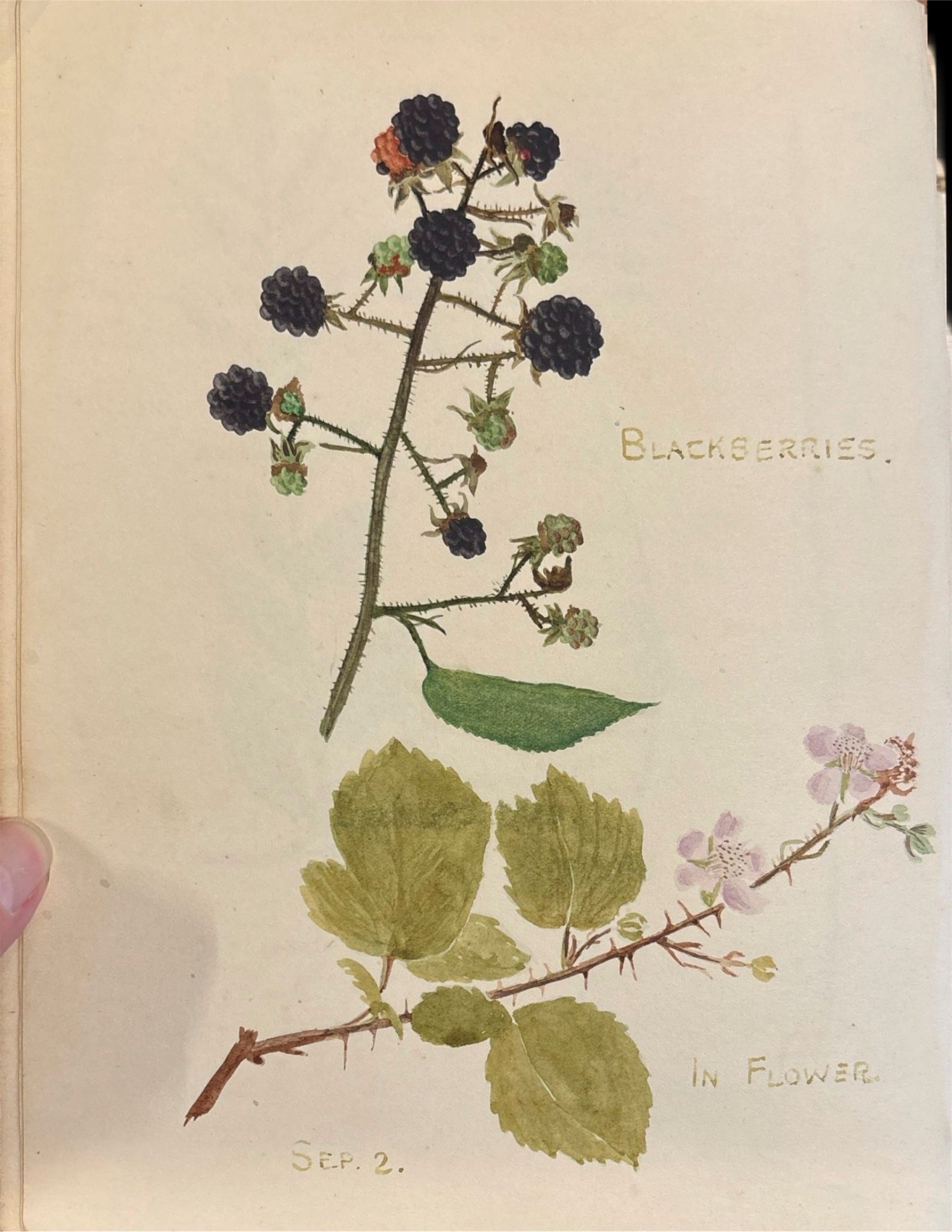
M. E. Deering, Scale How, 1937-1938
Various excerpts from Elizabeth’s nature notebook are included below with a few accompanying comments. Note the varying types of entries and observations.
A Word of Thanks
The excerpts shared are only available thanks to the continued work of the Armitt Library and Museum Centre to preserve and provide access to these materials, and CMI is grateful for our ongoing partnership with the Armitt.
- Interested in more? Click here, and we’ll send further excerpts from the notebook as well as the full scan of her earlier childhood notebook straight to your inbox.
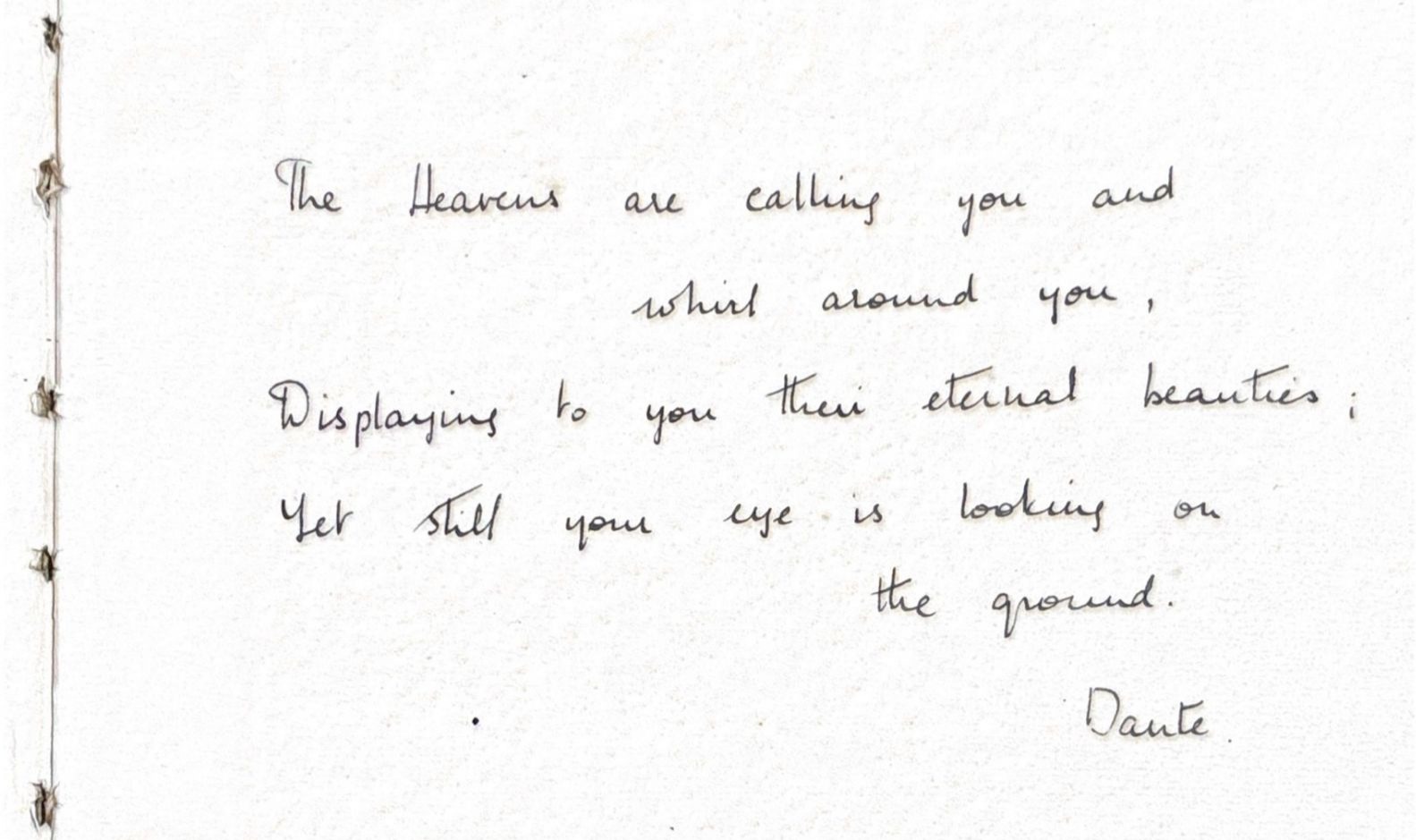
Undated poem
Elizabeth's notebook features several different poems, included this excerpt by Dante.
The Heavens are calling you and
whirl around you,
Displaying to you their eternal beauties
Yet still your eye is looking on
the ground.
~ Dante
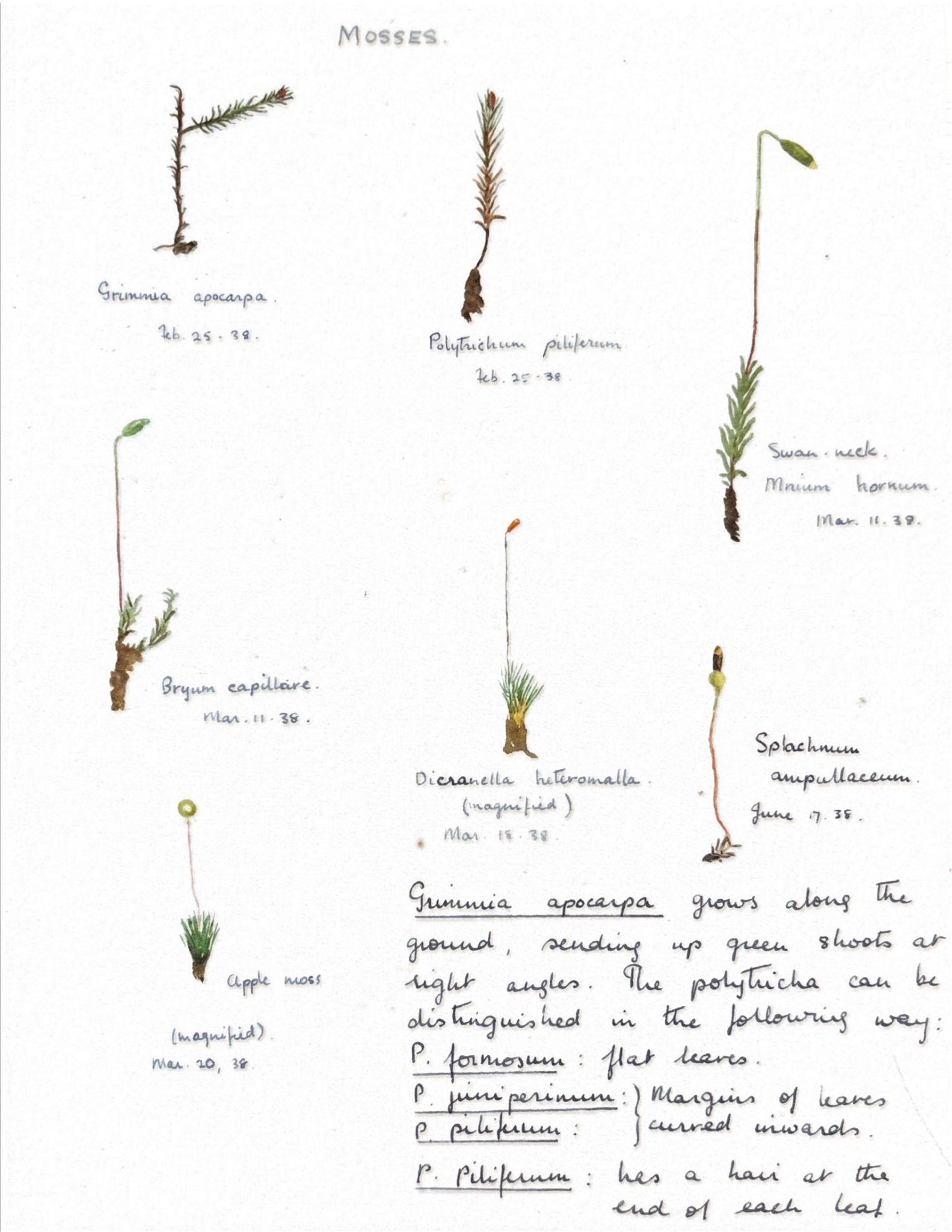
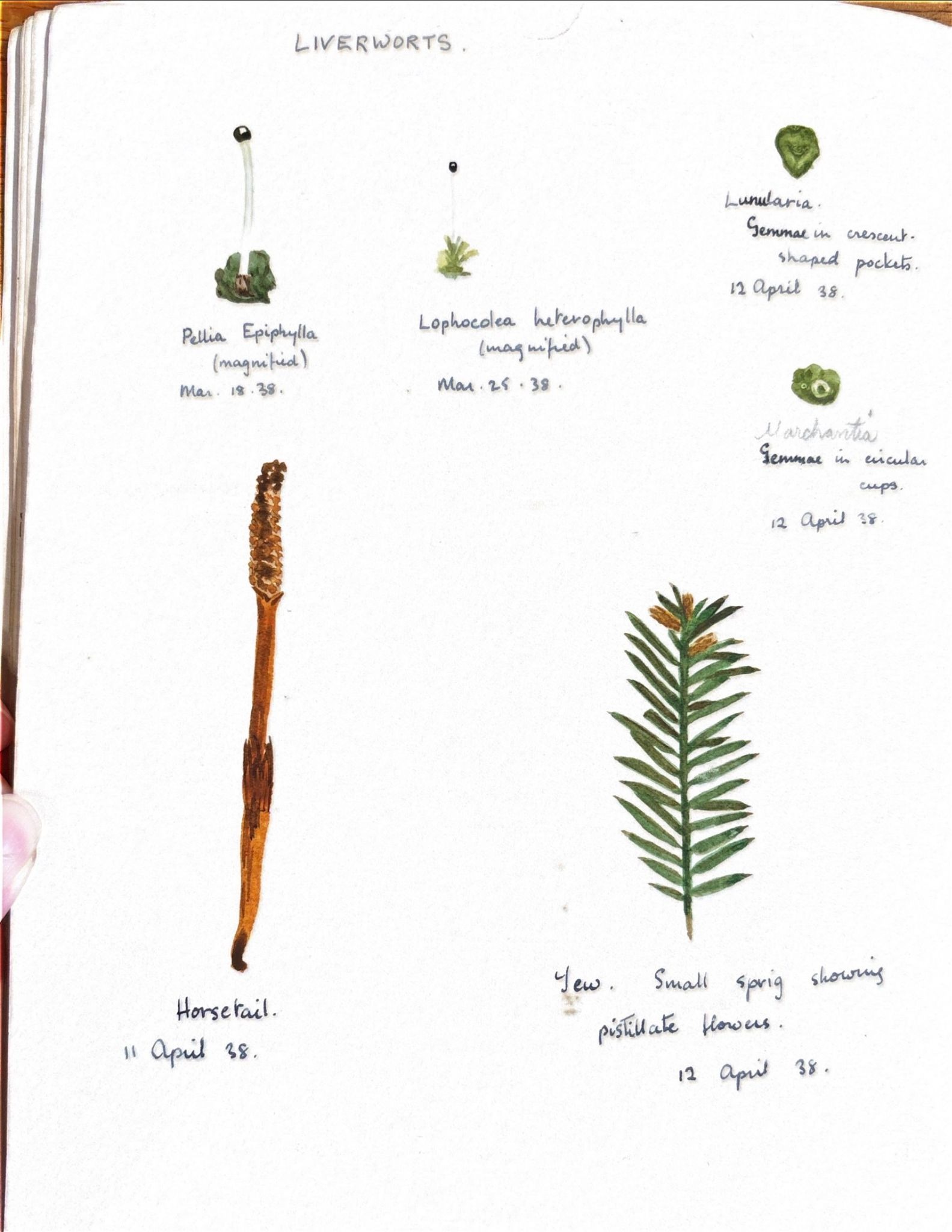
Sketches & Special Studies, Spring 1938
Special studies were focused on Mosses and Liverworts. Notice how Elizabeth decided to dedicate a page to these sketches and added to it over many different sessions.
Writing Entries, May-June 1938
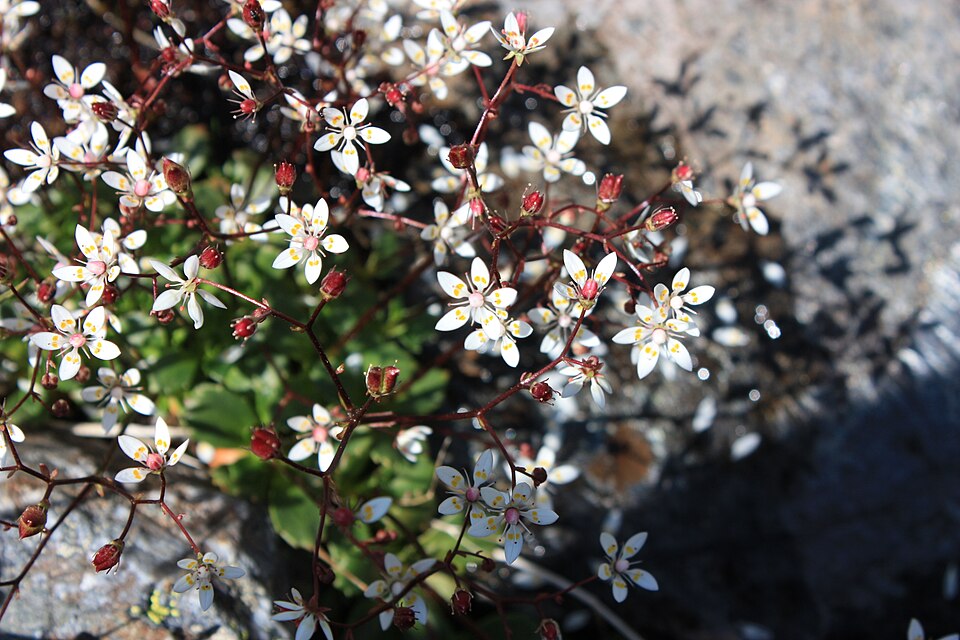
MAY 30: We went up Helvellyn for our half Term excursion, starting from Wythburn Church. Thirlmere was looking remarkably low, and there were two or three feet of mud round all the coast. There was a great quantity of a small crucifer very like scurvy grass, it was identified as Alpine Scurvy grass. There was one plant that I saw, of a flower like the garden saxifrage, with a white flower about 1/2” across and very much divided leaves—cut-leaved saxifrage. Star saxifrage was a new flower for me, it is a very pretty plant with serrate leaves, pale pink flowers resembling London Pride, each petal with a pair of dark pinkish-mauve spots near the base. We heard several sky larks.
Star Saxifrage pictured above
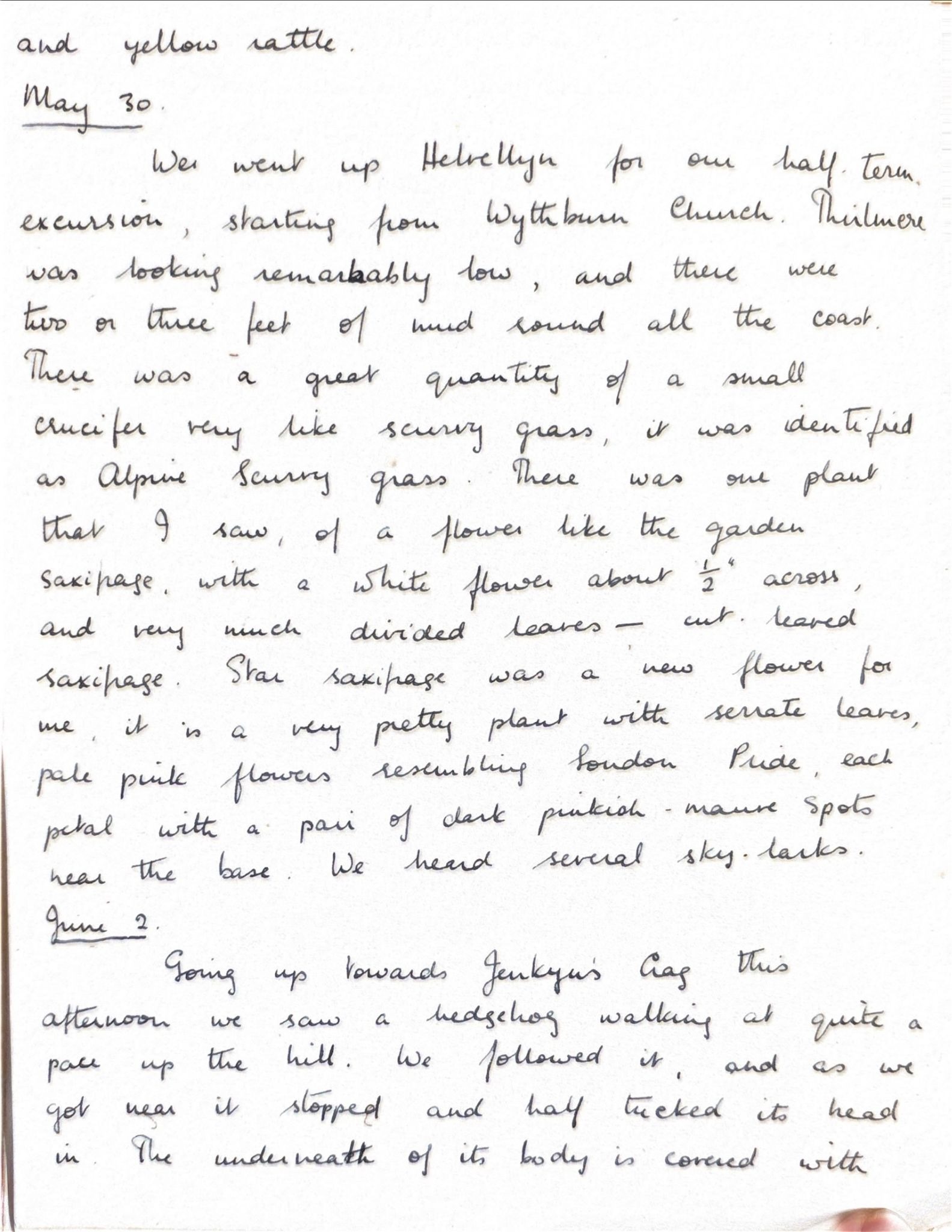
JUNE 2: Going up towards Jenkyn’s Crag this afternoon we saw a hedgehog walking at quite a pace up the hill. We followed it, and as we got near it stopped and half tucked its head in. The underneath of its body is covered with … [next page not scanned]
JUNE 16: We cycled to Wrynose Pass this afternoon and climbed Pike O’Blisco, though we did not quite reach the top as we had to be back by seven o’clock. Unfortunately the atmosphere was slightly hazy, but we had a very good view. The tarns were an extraordinarily brilliant blue, and the whole view was typically summery. Everything was much farther on than round Ambleside, we saw strawberries which were quite red on one side, but still too hard to eat. There were some lovely maintain rose bushes, they are such a deep pink compared with the dog roses On the way back, just before Clappersgate, on the left of the road we found a vetch, which was identified on our return as Common Vetch. It had simple flowers of a very bright rose madder colour, wheres most other vetches have several flowers together in each leaf axil. There was a great deal of Greater Celandine growing along the roadside about half-way to Wrynose, it does not seem to grow in the immediate neighbourhood of Ambleside.
JUNE 25: We went up the Sweden Bridge valley this afternoon, and on the way we noticed a redstart. It seems to have such red under its tail, which shows when the bird is in flight. We looked in several boggy places for the sundew, but it does not seem to be out yet. Some plants were very nearly out, but apparently it remains in that stage for a long time. Bog asphodel [image below] too was only in bud, but it has been seen on Loughrigg. Just a few yards higher up the stream than Sweden Bridge, we saw a huge fungus growing out from the stump of a tree. It must have been nearly a foot across, and was one of the porous bracket fungi.
%2C_Cranes_Moor%2C_New_Forest_-_geograph.org.uk_-_495045.jpg)
%2C_Lodz_(Poland).jpg)
Bog asphodel and Common Redstart pictured above.
Charts
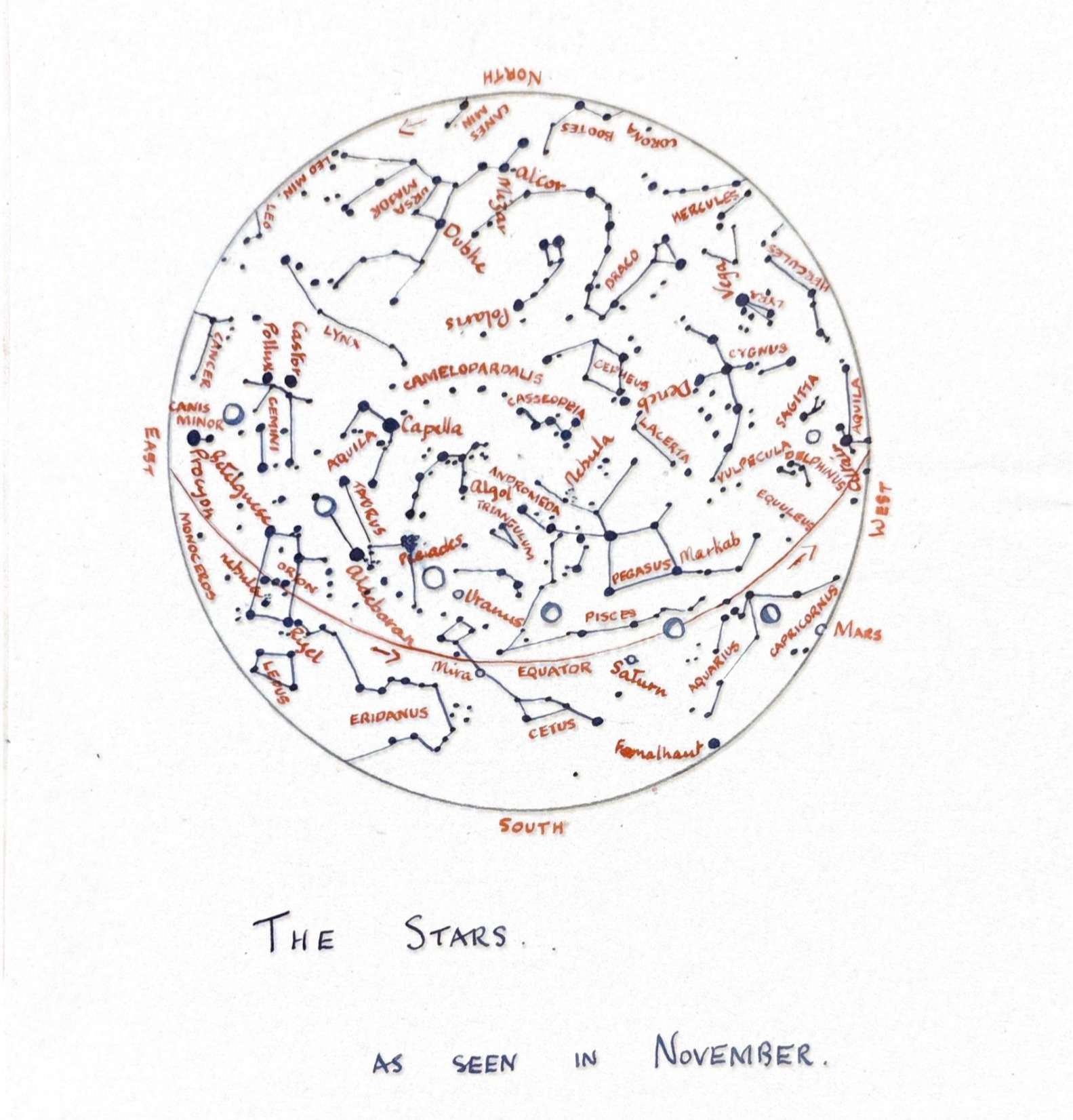
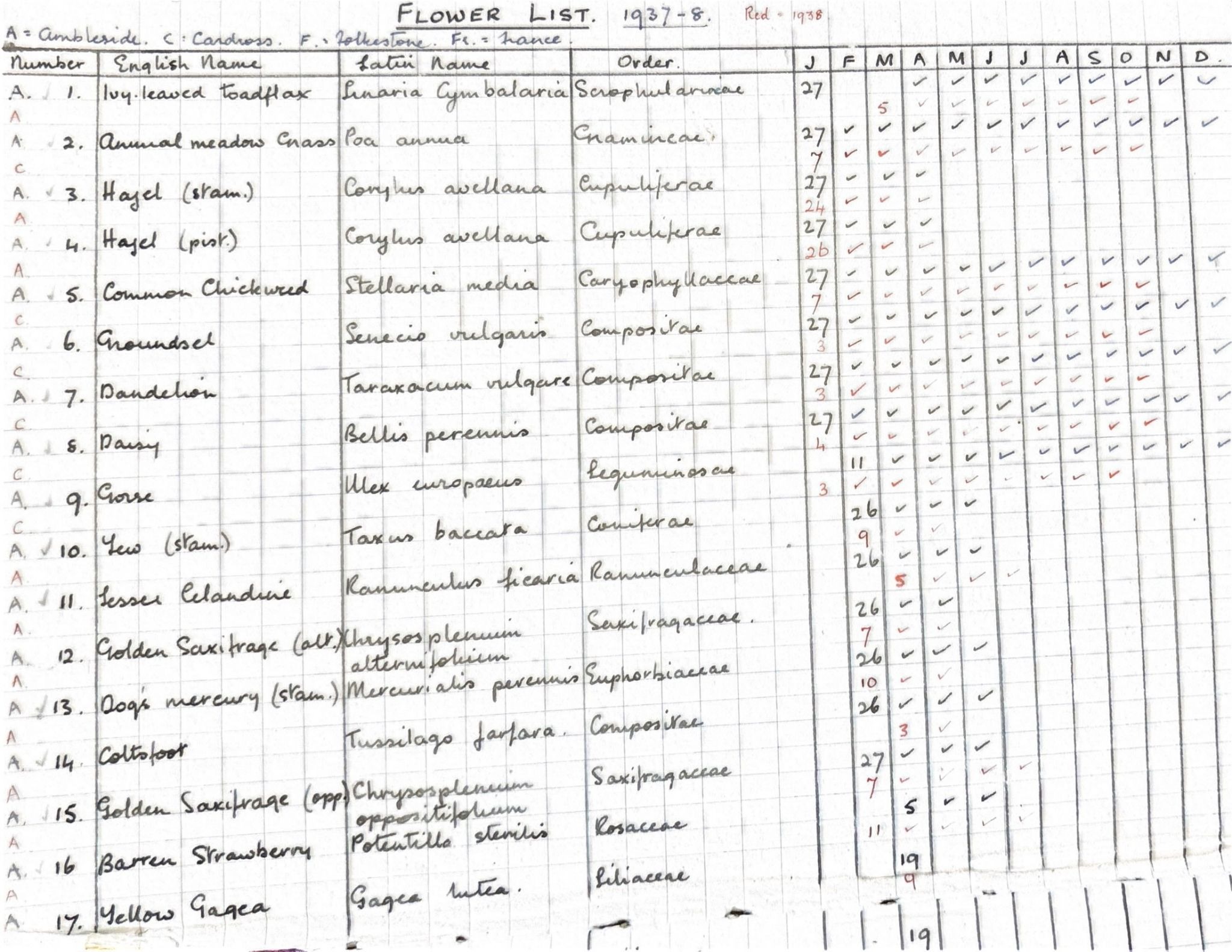
In her early nature notebook, Elizabeth mentions flower lists and notes how many they found on particular walks and across the season. In her college notebook, she includes a list she made of the flowers she found and how often she saw them. There is also a chart of the constellations in the November sky.
Evaluation & Graduation
One of unique aspects of Elizabeth’s story is how it intersects with a report in the Parents' Review. In Volume 50, the “Our Work” section of Issue 1 which came out in January of 1939 includes a report on Elizabeth's class, the Charlotte Mason College class of 1938.
The General Report
In the report, Professor de Burgh, Emeritus Professor of Philosophy at the University of Reading, notes that he completed his “twenty-first visit of inspection to the Charlotte Mason College (to be warmly congratulated on its new name) between November 28th and December 1st” (p.137). Besides a new name, The College had also recently acquired a new Principal. Essex Cholmondeley (whom many know as one of Charlotte Mason’s biographers) had passed the baton to Miss van Straubenzee. More relevant to Elizabeth’s story, it seems Miss Agnes Drury was transitioning from more active day-to-day teaching at the Charlotte Mason College to chief examiner of Nature Note-books.
Professor de Burgh writes that his “inspection followed usual lines.” He heard criticism and reading lessons, attended lectures and class-instruction given by the Principal and Vice Principal, saw or heard Craft Work, Drill, Dancing, Singing, and “Solo Pianoforte Playing by one of the students who is qualifying for her L.R.A.M,” attended a student performance, and gave an address himself (p.137).
He also conducted written examinations which consisted of two papers “on the Theory and Methods of Education respectively” and then a second round of written exams a few weeks later for those who passed the first part. These second papers consisted of essay on the History of Education, Plato’s Republic, and another unspecified Essay (p.137-138).
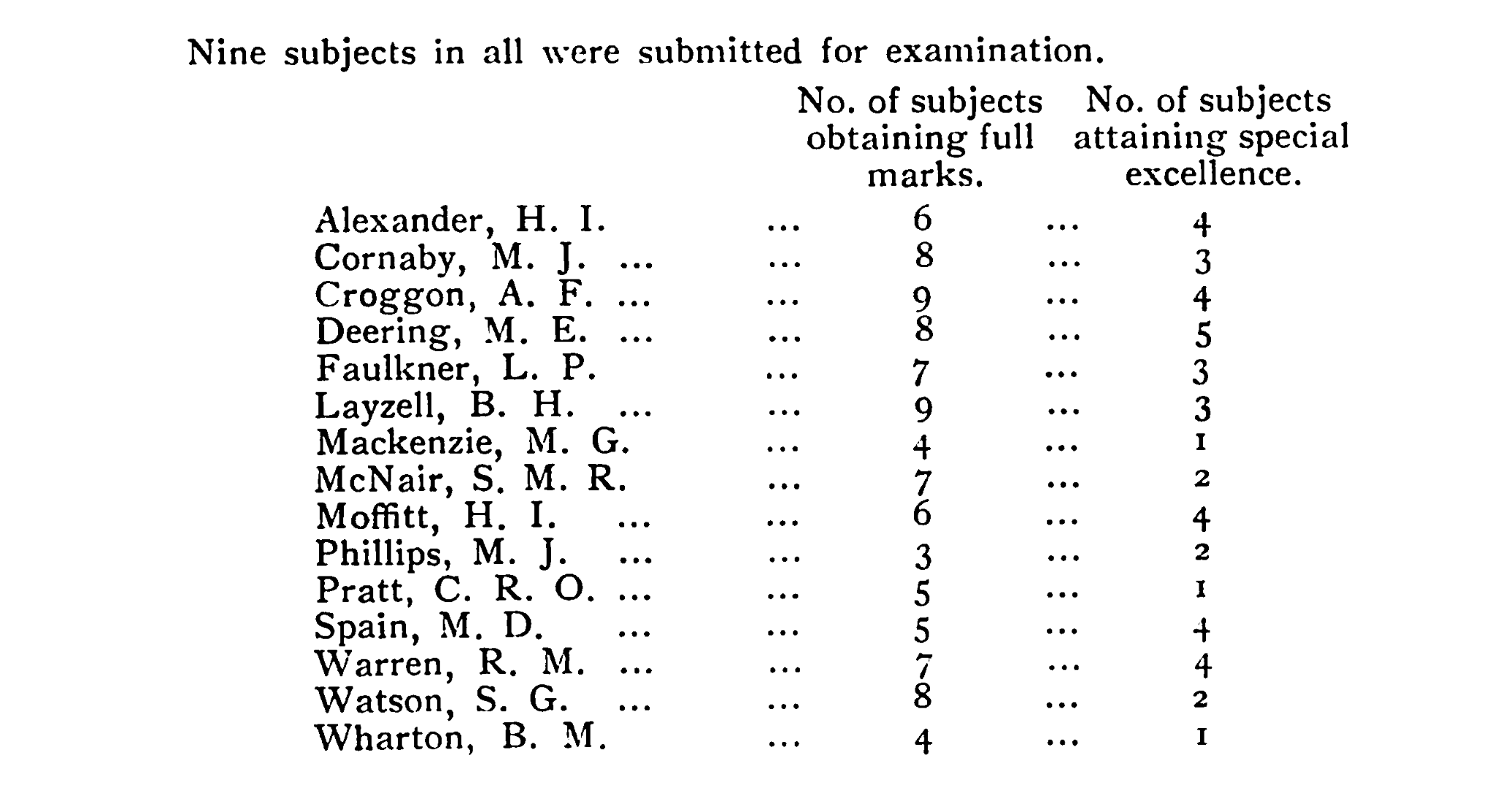
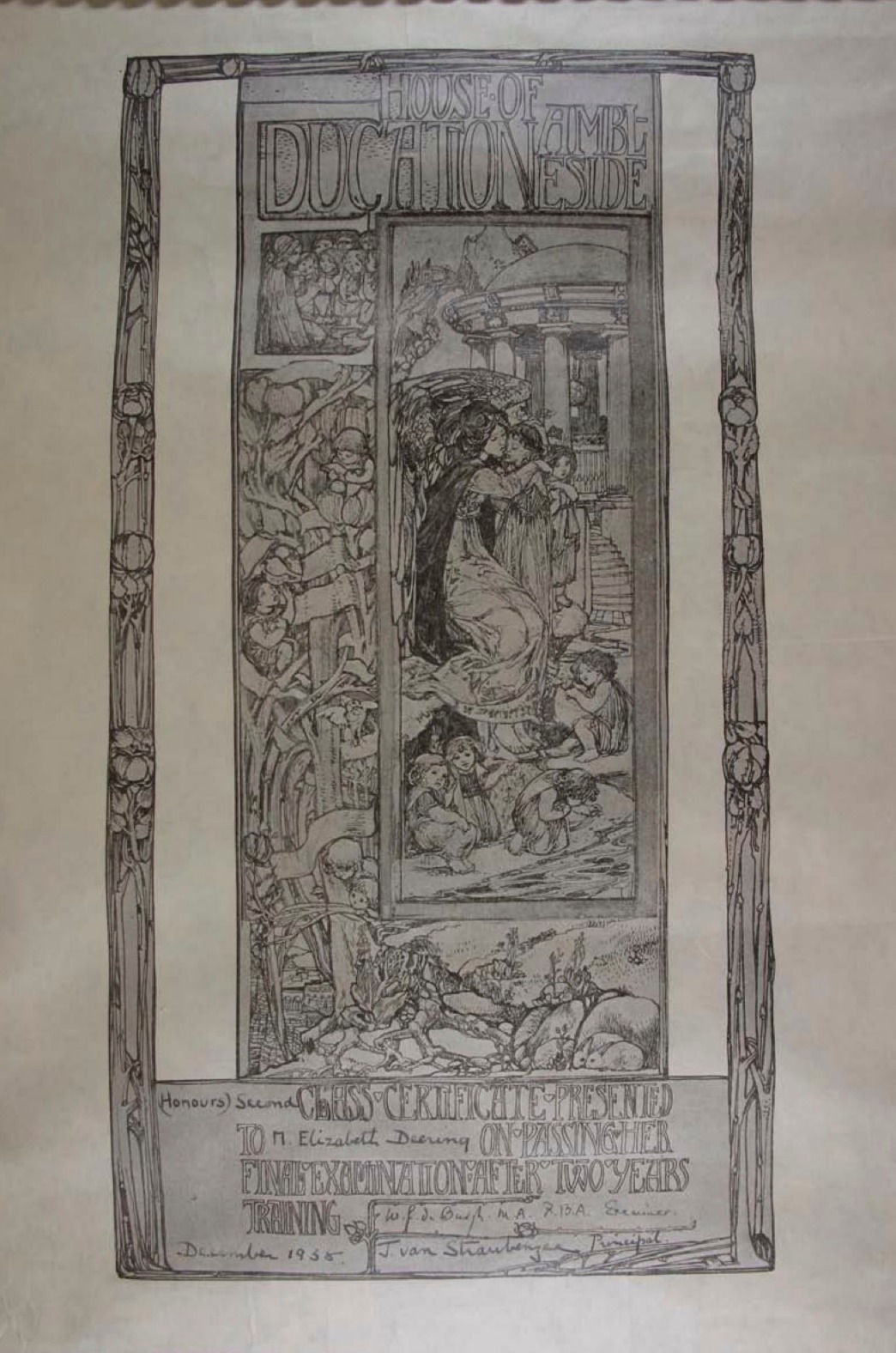
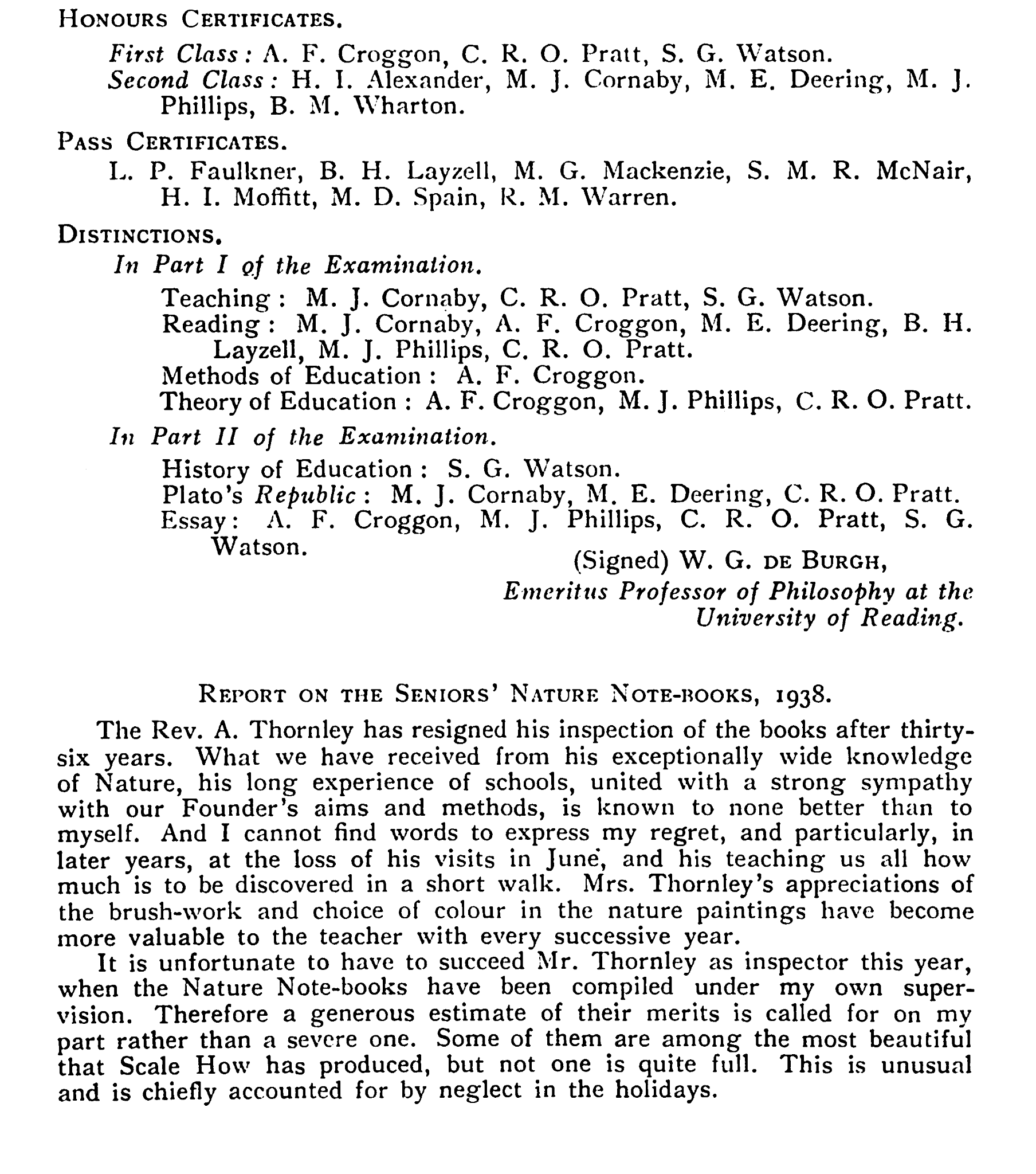
Elizabeth apparently did quite well as she passed both sections of the exam and was awarded the Honours Certificate. The report notes that her Reading lesson and essay on Plato’s Republic were especially good. In the summary section of the report, it appears that out of the nine subjects which made up the final exam, Elizabeth obtained full marks in eight of them and “special excellence” in five of those. (The Charlotte Mason Archive also includes Elizabeth’s original graduation certificate from the House of Education – interesting that the certificates did not yet show the College’s new name).
Nature Notebooks Reviewed
In one of the last sections of the class report, Agnes Drury writes a review of the students’ nature note-books. Curious to hear her comments?
Report on the Seniors’ Nature Note-books, 1938.
“The Rev. A. Thornley has resigned his inspection of the books after thirty-six years. What we have received from his exceptionally wide knowledge of Nature, his long experience of schools, united with a strong sympathy with our Founder’s aims and methods, is known to none better than to myself. And I cannot find words to express my regret, and particularly, in later years, at the loss of his visits in June, and his teaching us all how much is to be discovered in a short walk. Mrs. Thornley’s appreciations of the brush-work and choice of colour in the nature paintings have become more valuable to the teacher with every successive year.
It is unfortunate to have to succeed Mr. Thornely as inspector this year, when the Nature Note-books have been compiled under my own supervision. Therefore a generous estimate of their merits is called for on my part rather than a severe one. Some of them are among the most beautiful that Scale How has produced, but not one is quite full. This is unusual and is chiefly accounted for by neglect in the holidays.
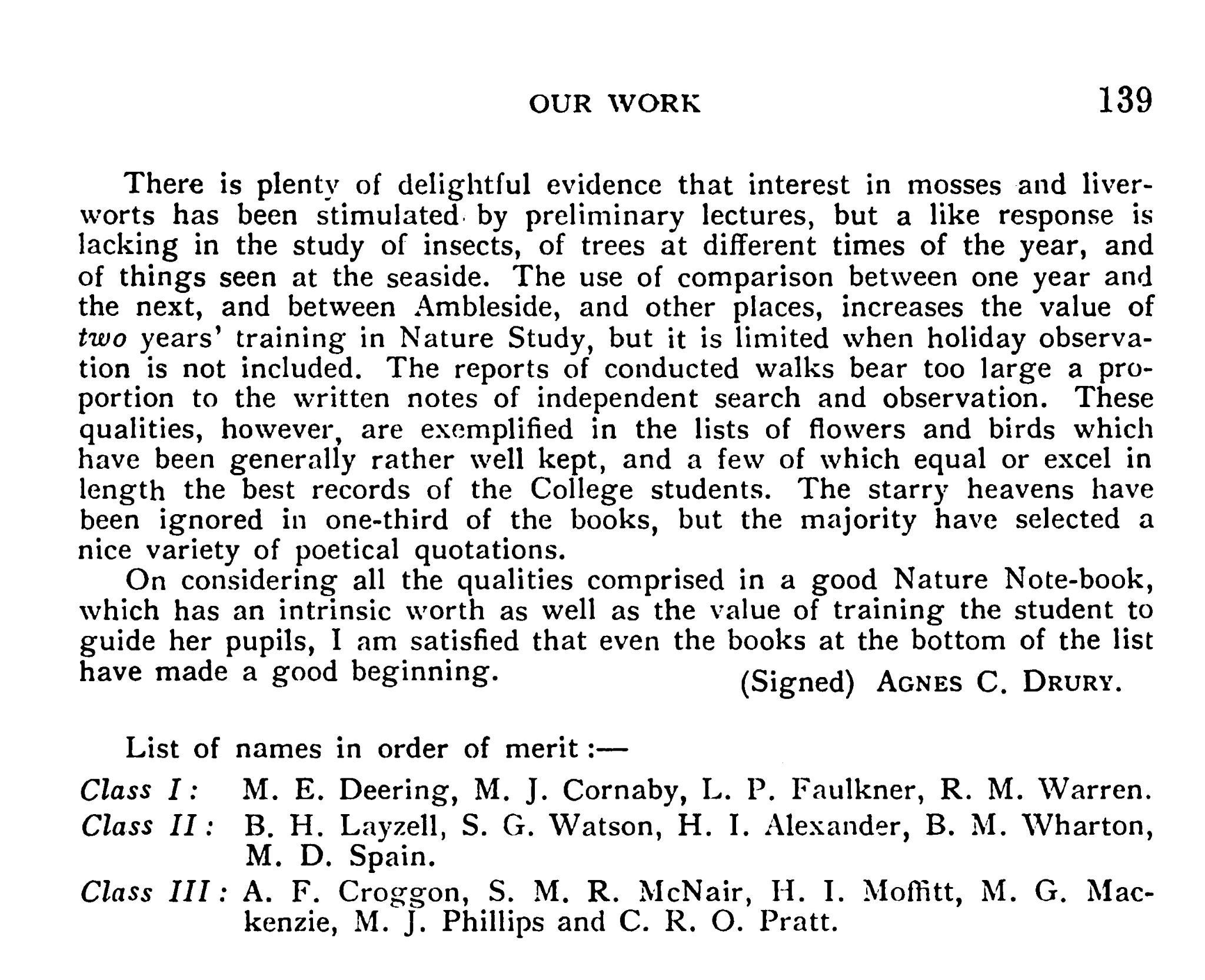
There is plenty of delightful evidence that interest in mosses and liverworts has been stimulated by preliminary lectures, but a like response is lacking in the study of insects, of trees at different times of the year, and of things seen at the seaside. The use of comparison between one year and the next, and between Ambleside, and other places, increases the value of two years’ training in Nature Study, but it is limited when holiday observation is not included. The reports of conducted walks bear too large a proportion to the written notes of independent search and observation. These qualities, however, are exemplified in the lists of flowers and birds which have been generally rather well kept, and a few of which equal or excel in length the best records of the College students. The starry heavens have been ignored in one-third of the books, but the majority have selected a nice variety of poetical quotations.
On considering all the qualities comprised in a good Nature Note-book, which has an intrinsic worth as well as the value of training the student to guide her pupils, I am satisfied that even the books at the bottom of the list have made a good beginning.
(Signed) Agnes C. Drury
(from p.138-139 of the report published in Our Work)
On Nature Note-booking
These brief notes give interesting background to the training Elizabeth received. She went on guided walks and listened to lectures on particular subjects, but she was also asked to make independent observations. There were specific focuses during various seasons. Her notebooks became the location of scientific inquiry as well as literary reflection–including flowers charts and observations across years as well as relevant poetry. And she, like many students then and now, did not always keep up the habit of notebooking during holidays as consistently as she did during the term.
There are no further records of M.E. Deering in the Parents’ Review, but perhaps she went on to teach at a P.U.S. school or work as a governess in a home context. Regardless, her nature journals somehow ended up in Ambleside, which perhaps indicates that she continued to find inspiration and value in the habit of notebooking that she was first introduced to at six, trained in during her College years, and which she doubtless carried with her the rest of her life.
- Interested in more? Click here, and we’ll send further excerpts from the 1937-1938 notebook as well as the full scan of Elizabeth's earlier childhood notebook straight to your inbox.
Want to Explore Further?
For more on notebooks and nature study in a Charlotte Mason education, you may enjoy this short video on all the different notebooks in a relational education, 12 Tree Walks from our Alveary Nature study resources, CMI Natural History Guides, a post about nature notebooking for a student with learning challenges, and a Mom's experience growing with her own nature notebook.
